
World Market Summary
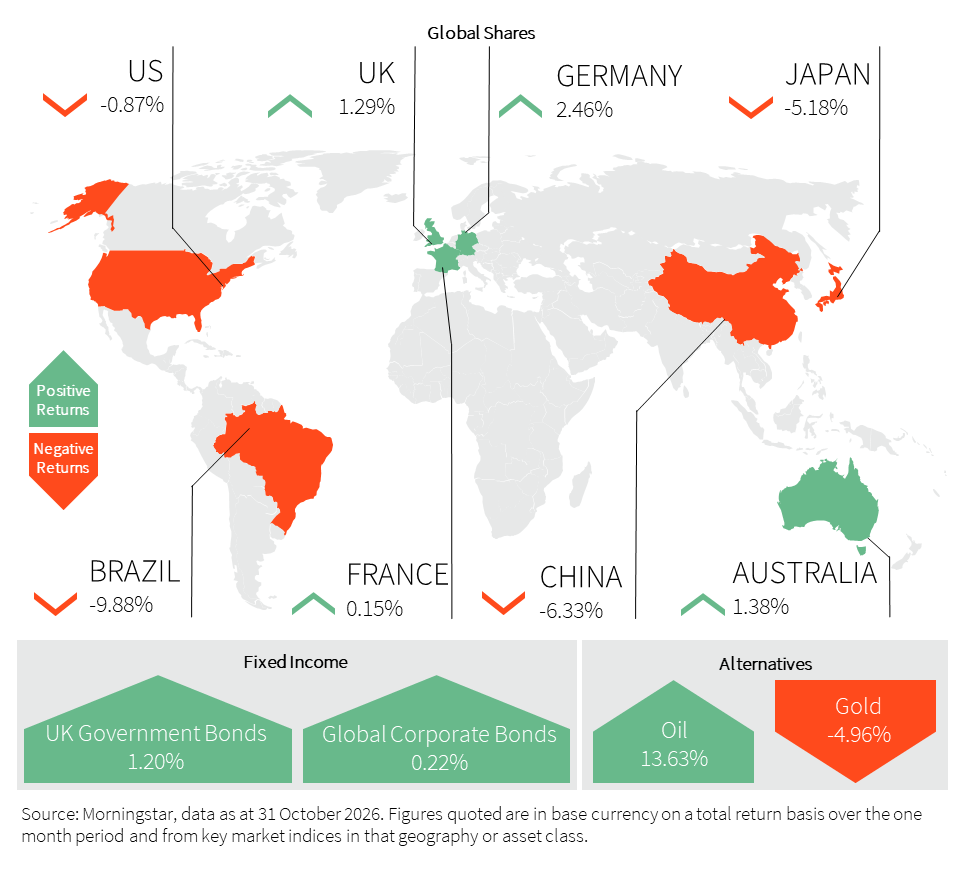
October was greeted with oil prices surging towards $120, French government bond yields surpassing 5% for the first time in 24 years and increasingly negative free cash flow from the tech giants, which combined to test market participants’ ‘fight or fright’ reactions. The overarching choice was ‘fright’ as the end of the month drew nearer, demonstrated by the Nasdaq briefly falling into correction* territory and Apple replacing Nvidia as the world’s largest company with a valuation in excess of $5 trillion as investors sought refuge in its surging free cash flow. A ‘flight to safety’ was witnessed across the board, with the high-yielding UK market one of the strongest, up 1.29% as the UK Chancellor of the Exchequer, John Healey, delivered a relatively uneventful Autumn Budget. Meanwhile, Asian technology-focused markets like Korea and Japan struggled alongside the Nasdaq as AI fears grappled the market. Gold’s utility as a liquidity source also saw it dragged down 4.96% over the month. Within the hyperscalers, the increasingly selective nature of the market continued with Microsoft receiving a positive share price reaction to its results and continued positive cash flow in contrast to Amazon, Alphabet’s and Meta’s negative reaction and free cash flow figures. However, the market may be overly short-term focused, as Amazon’s CEO Andy Jassy suggested: “we’re in a 10 to 20 year cycle”.1 As we move into November, Anthropic will be hoping the market quickly changes tack as it looks to list before Thanksgiving and will be hoping to be met by a market comfortable with not only negative free cash flow but negative profits.
Global bond markets have been particularly volatile, with similarly diverging performance regionally. Whilst French government bond yields surged, the US 10-year government bond corrected back towards 5% after the surge in yields in September. This was largely due to a readjustment in growth expectations linked to the AI narrative, given the importance of AI capital expenditure at the macro level. The Atlanta Federal Reserve (Fed) Gross Domestic Product (GDP) growth forecast for Q3 2026 converged from 5% at the end of September to the actual figure of 3.4% announced in October, an acceleration from 2.2% in Q2 2026. Given the hyperscalers’ continued announcements of accelerating AI capital expenditure, there appears to be little reason for marked downside in US growth, which will help to keep bond yields elevated alongside the continued sovereign and corporate bond issuance.
As well as Anthropic’s IPO, November will see the US midterm elections, which have already been a source of volatility and will likely generate more in the coming month. Nevertheless, the President often has less power to enact a large amount of policy changes as a result of these elections, which provides a good environment for equity returns. The S&P 500 has been higher six and 12 months after every midterm election in the last 75 years, and with valuations looking healthier after the recent pullback, the backdrop for equity returns is very positive.
*Market Correction: A market correction is a market decline that is more than 10% but less than 20%.
Our in-depth views on:
Our weightings are based on sterling as a base currency.
United Kingdom (UK)
UK equity markets enjoyed a resilient performance in October as defensive and traditional sectors outperformed in the wake of a rotation out of technology stocks. Results were also key, as some of the largest constituent companies in the FTSE 100 impressed with Shell, AstraZeneca and Unilever gaining through the period. Unlike other Labour Budgets of late, the 2026 Autumn Budget proved sanguine, with gilt yields easing back as John Healey reaffirmed his commitment to fiscal discipline and avoided the large tax rises or unfriendly business policies that his predecessor employed.
The latest inflation reading showed an acceleration to 3.5% in September as higher energy and diesel prices drove the figure past the 3.4% expected. Core and services inflation also increased, showing that the effects of the Middle East conflict are starting to spread across the wider economy. As such, the Bank of England (BOE) is widely expected to increase rates at their November meeting. Economic growth surprised to the upside with August showing a 0.1% rise against forecasts of a decline. Impressively, economic growth has beaten or matched expectations every month this year.
The Autumn Budget brought a series of policy measures directed at business. For retail, hospitality and leisure, there was welcome news in that the threshold for 100% small business rates relief was raised from £12,000 to £18,000. All other businesses will also see their business rates frozen in real terms for the next two years. In addition pubs, social clubs and smaller live music venues will receive an extra 20% business rates relief from April 2027. For housing, the ‘Your First Home’ scheme was confirmed for first-time buyers allowing buyers to put down just a 2.5% deposit supported by a government-backed equity loan of 20%. In a slight disappointment for some, the scheme won’t commence until April 2027. In defence, Healey outlines a target of 2030 for defence spending to hit 3% of GDP and reaffirmed the NATO commitment of 3.5% by 2035, with next year’s spending review outlining how this will be met.
United States (US)
US equities fell in October as investors rotated away from large-cap growth stocks towards value and defensive sectors. The Nasdaq underperformed the S&P 500, declining 6.63%, as high-beta** and AI-related stocks came under pressure. Concerns over the sustainability and financing of AI investment were a key driver, with higher yields increasing scrutiny of the returns on substantial capital expenditure. However, the sell-off appeared to run ahead of underlying fundamentals. Semiconductor prices and Graphics Processing Unit (GPU) rental costs continued to rise, while guidance from Taiwan Semiconductor Manufacturing Company (TSMC) and Micron pointed to demand exceeding supply until at least 2028. Hyperscalers’ returns on invested capital also remained comfortably above their cost of capital, suggesting that demand for AI infrastructure remains robust despite growing scrutiny of investment levels and financing.
Economic data continued to point to resilient activity. US GDP expanded by 3.4% in the third quarter 2026, above expectations, supported by business investment and consumer spending. October business surveys also remained relatively strong, with manufacturing and services activity expanding at a pace close to a five-year high, although growth moderated. Consumer confidence was mixed, while inflation expectations edged higher and businesses reported their sharpest increase in selling prices, keeping price pressures in focus.
The Fed held interest rates unchanged in October, although two members dissented in favour of a hike. Policymakers upgraded their assessment of economic activity but remained dependent on incoming data. Attention now turns to November’s midterm elections. One key question is the degree to which democrats gain power. If Congress is divided, then we will likely see few policies being passed and this absence of political volatility should be positive for risk assets.
**Beta: Beta is a metric for the degree to which an individual stock, asset, or portfolio’s price moves in relation to the overall stock market (such as the S&P 500). The higher the beta, the more risky the stock, asset or portfolio is perceived.
Europe
European equities held up relatively well in October, delivering a positive return in sterling terms, supported by their defensive characteristics amid a global sell-off in high-beta and technology stocks. Q3 2026 earnings were mixed across sectors. Energy companies reported particularly strong results, supported by higher commodity prices and trading activity, while financials saw more varied outcomes as some banks faced pressure from softer net interest income and funding costs. Luxury goods earnings disappointed, while semiconductor companies reported solid underlying results despite continued volatility in their share prices amid the wider technology sell-off.
Economic data presented a mixed picture. Eurozone GDP grew by 0.4% quarter-on-quarter in Q3 2026, ahead of expectations, suggesting activity remained more resilient than feared. However, the Purchasing Managers’ Index (PMI) eased in October, indicating a slower pace of expansion. France remained a particular weak spot, with protests over living costs and the government’s €54bn austerity Budget adding to concerns over its economic and fiscal outlook. French assets found some relief after protests passed without serious incidents and Moody’s retained their credit rating. However, the negative outlook remained, reflecting continued uncertainty over fiscal consolidation and the adoption of the 2027 budget.
The European Central Bank (ECB) held interest rates unchanged, although policymakers discussed a possible hike amid persistent inflation concerns. The debate reflects the challenge of containing energy-driven price pressures without placing further strain on an already uneven recovery. With growth slowing and inflation risks still elevated, the prospect of further monetary tightening remains a headwind for the regional outlook.
Asia and Emerging Markets (EM)
Emerging market equities came under pressure in October, with weakness in China, Korea and Brazil outweighing positive contributions from India. A sharp reversal in AI-related stocks was a common driver across Asian markets, as investors reassessed the sustainability of technology investment and semiconductor valuations.
Chinese equities were among the main regional laggards, as mainland technology and AI-related stocks led the sell-off. Hong Kong held up better, supported by recoveries in consumer, financial, energy, property and selected internet shares. China’s economy grew 4.5% year-on-year in Q3 2026, while industrial profits accelerated to 14.4% in September. However, no new stimulus measures were announced at the Fifth Plenum, with stronger headline growth reducing the urgency for broad-based support.
Korean equities also faced significant selling pressure as concerns over AI investment returns, higher financing costs and competition from Chinese chipmakers outweighed strong export fundamentals. Semiconductor exports rose 222% year-on-year in October to a record level, accounting for 45% of total exports. The Bank of Korea (BoK) held rates at 3.0%, pausing after two consecutive hikes to assess their impact.
Japan was similarly affected by the global technology sell-off. Meanwhile, Tokyo core inflation rose to 2.6% year-on-year in October, while retail sales growth slowed to 2.3% in September, below expectations. The Bank of Japan (BoJ) held interest rates at 1.25% and announced plans to more than double the pace of Exchange-Traded Fund (ETF) sales from January 2027, continuing its gradual unwinding of assets accumulated under previous stimulus programmes. Given the measured pace of sales, the market impact is expected to be limited.
India provided a positive offset, with software exporters benefiting from improving earnings expectations and a rotation away from semiconductor stocks. The International Monetary Fund (IMF) also raised its 2027 growth forecast to 7.0%, although rising inflation risks prompted the Reserve Bank of India (RBI) to raise interest rates by 0.25% to 5.5%.
Elsewhere, Brazil’s market came under significant pressure after Lula’s Presidential re-election triggered an unwinding of positions built ahead of the vote. The election result renewed concerns over the country’s fiscal outlook and future economic policy.
Fixed Income
After poor performance in September, a pullback in yields allowed bonds to play their key role in portfolios as a ballast in times of equity market weakness. The month began as September ended, with the US 10-year yield reaching a high of 5.3%, its highest level since 2002, before falling back as investors sought safety during the tech sell-off. Over the month, the 10-year Treasury yield eased back to 4.93%, while the 10-year gilt yield fell from 5.42% to 5.28% as the UK Budget passed without incident, vindicating the market’s earlier willingness to give the Chancellor the benefit of the doubt. In Japan, the 10-year government bond yield dropped back from 3% to 2.84%.
The relief, however, owes more to risk aversion than to an improved policy outlook. Inflation remains above target and is moving in the wrong direction. Central banks continue to lean hawkish in response. The Fed held interest rates yet two policymakers dissented in favour of a hike. The market is now placing an 80% probability on a December hike from both the BoJ and the ECB and 75% from the Fed, with a further 0.25% hike priced in for each in 2027. In the UK, the market has priced in near certainty of a first hike since 2023 at the BoE’s November meeting given the recent inflation surprise. The ECB held interest rates at 2.50%, leaving the resignation of the ECB President, Christine Lagarde to take centre stage. The BOJ held at 1.25% on 30 October but raised its inflation forecast, and most economists now expect a hike in December this year.
Credit spreads widened to 1.29% on the Bloomberg Global Index (BGI), with the extra yield investors demand to hold corporate bonds over government debt hitting its widest since May 2025, with the widening in spreads particularly marked for AI-related companies.
Alternatives
Oil prices climbed towards $120 as the Middle East conflict continued to disrupt energy prices. Despite Trump pledging that the US would not resume airstrikes against Iran before the midterm election the sharp jump in prices was not reversed. However, there were some signs of relief on the supply side, leaving the elevated oil price largely a reflection of geopolitical risk premium. Combined exports from Saudi Arabia, the UAE, Iraq and Kuwait rose 10% to 15.53 million barrels a day in October, roughly in line with levels shipped at the start of the year, which should help moderate prices as we head into year-end.
Gold fell to an 11-month low of $3,940 and was down 4.96% over the month, despite the easing in bond yields, which reduces the opportunity cost of holding the metal. US dollar strength continued to weigh, with the dollar index near the top of its 52-week range as investors favoured the greenback as the safe haven of choice and used gold as a source of liquidity. However, the underlying trend remains strong for the precious metal. Central bank buying jumped 42% to 321 tonnes in Q3 2026, the highest quarterly total since Q4 2024, lifting year-to-date demand to 675 tonnes, with Poland and China leading officially reported purchases. Weaker prices likely encouraged some of this buying. The World Gold Council cut its 2026 gold investment growth forecast to 200 tonnes from 400 tonnes on weaker demand for bars and coins, although it raised its central bank estimate. With inflation still elevated, gold’s long-run role as an inflation hedge remains intact.
Property
In the US, the housing sector remained under pressure in October, with demand weighed down by persistently high mortgage rates. The US 30-year fixed rate averaged 7.40% in recent weeks, its highest level in nearly three years. Pending home sales fell 11.3% year-on-year in September, the steepest decline since August 2023, with weakness across all regions. Housing starts fell 5.2% month-on-month to a seasonally adjusted annual rate of 1.221 million, a third consecutive monthly decline.
According to Nationwide, UK house prices rose just 0.5% over the last year, down from 0.8% and the weakest growth since January 2024. Prices were unchanged on a monthly basis, following a 0.3% decline. Nationwide Chief Economist Robert Gardner noted that conflict in the Middle East has pushed energy prices higher, lifting expectations of Bank Rate*** increases and keeping upward pressure on mortgage rates. Surveyors report weak buyer enquiries and consumer confidence fell in October, pointing to further softness. However, Gardner said the market could regain momentum once the energy shock fades, supported by resilient growth, employment and real incomes, and improved affordability as income growth has outpaced house price growth. The new first-time buyer scheme announced in the UK Budget should also support housing demand going forward. Construction PMI also offered a bright spot in the gloomy housing data, with the slowest decline in construction output since January this year.
***Bank Rate (also known as the base rate): is the core interest rate set by a country’s central bank.
Learn more…
For more industry terms and definitions, visit our glossary here.
Important Information
All Index data figures are sourced by Morningstar and correct as at 31 October 2026, unless otherwise stated.
1Source: Amazon News, ‘Q3 earnings: Andy Jassy on AWS’ 39% year-over-year growth’ 30 October 2026.
The value of investments or any income arising from them may fluctuate and are not guaranteed. Past performance is not necessarily a guide to future performance.