
World Market Summary
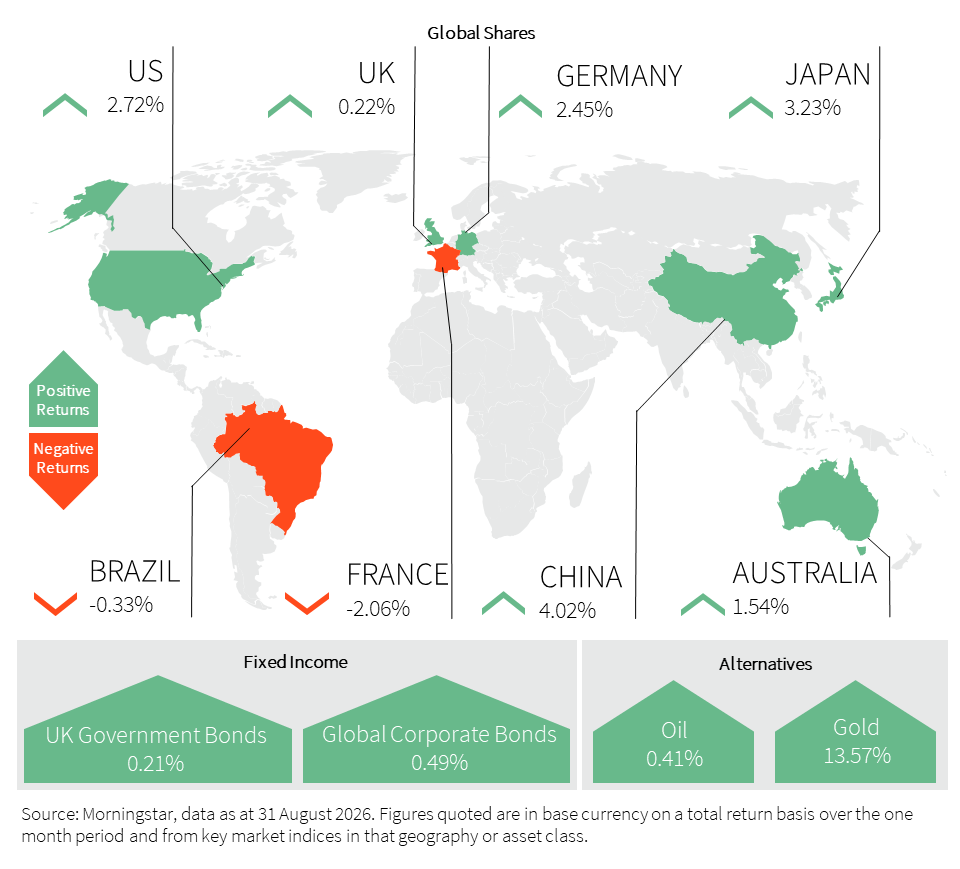
As the hottest summer on record comes to a close, the rain clouds have reemerged after a period when it felt like the sun spent more time behind the moon than clouds. However, stocks continue to shine as they refuse to be eclipsed by the global bond market sell-off. Fundamentals remain exceptionally strong, and market breadth is healthy despite Nvidia once again surpassing a market capitalisation of $5 trillion after stellar earnings and SpaceX recovering after its post-IPO sell-off.
Although trading volumes are at their lowest during the summer months, volatility remained very sanguine in both equity and bond markets throughout August. The absence of a sudden move in bond yields and the strength in earnings likely played a key role in enabling equities to continue to rise. The key force behind the bond market sell-off was hawkish commentary from Federal Reserve (Fed) Chair Kevin Warsh in his Jackson Hole speech. This largely offset US Treasury Secretary Scott Bessent’s debt buyback program, which attempted to tame the sell-off in treasuries. Bond yields also rose elsewhere given the international nature of the treasury market, and the Japan 10-year government yield is now flirting with 3%, a level not seen since 1996.
The sustained bond issuance from both corporates and sovereigns to support spending plans will likely continue to put upward pressure on bond yields. As long as growth and inflation remain above trend, equities continue to be the investment of choice. This was demonstrated by the Bank of America Fund Manager Survey, which found allocation to equities to be at the highest level for five years.
Gold also remains a popular inflation hedge and resumed its uptrend with a massive 13.57% move in August, as rising geopolitical tensions in the Middle East elevated the precious metal alongside the oil price.
Economic data remains broadly robust, with US manufacturing activity nearing a four-year high in July and the Atlanta Fed Gross Domestic Product (GDP) tracker predicts Q3 GDP growth at an impressive 4.8%. The labour market remains the main spot of weakness, with payrolls contracting and the labour force participation rate dropping to the lowest level since early 2021. Elsewhere, India reminded investors that AI isn’t the only game in town when it comes to growth, with Prime Minister Modi labelling the 7.8% Q3 GDP growth as a ‘herculean feat’.
Our in-depth views on:
Our weightings are based on sterling as a base currency.
United Kingdom (UK)
August was a relatively muted month for earnings releases and, by extension, UK equity performance, with the FTSE 100 up just 0.69%. Mid-caps outperformed strongly, up 4.34%, but this was flattered by the end-of-month bank holiday keeping the UK market closed after Warsh’s Fed speech. This delayed the inevitable upward pressure on UK gilts and downward pressure on smaller companies due to the typically larger amount of debt they hold. At the sector level, materials were strongest, given the strength in commodities over the month. Mergers and acquisitions remain a feature of the UK market, with Bodycote the latest to be purchased, once again with a US private equity firm as the buyer in the £1.65 billion deal.
The economic data was strong, with GDP growth beating expectations and accelerating from 0.9% to 1.2% in Q2 on an annualised basis. Private sector activity hit its highest level since April, and consumer confidence hit its highest level in two years. This string of good news could almost be taken as bad news, as it gives the Bank of England (BoE) more ammo to hike interest rates, but with core inflation contained at 2.6% and the labour market far from strong, we expect the BoE to remain on hold for now. Nevertheless, upward pressure on gilt yields is likely to continue with the budget looming and fiscal credibility still in question.
United States (US)
US equity markets posted their best August since 2021, with the S&P 500 rallying 2.72% and the Nasdaq surging 4.24%, snapping a two-month losing streak. The move higher continued to be driven by robust earnings with Nvidia’s earnings beat towards the end of the period capping off a very strong second-quarter earnings season. Risks, however, rumble in the background with the ongoing Middle East conflict keeping inflation expectations elevated and concerns over US debt, which topped $40 trillion in the month, pushing the US 30-year Treasury yield to a level not seen since summer 2007.
Fed Chair Warsh used his first Jackson Hole speech to underline a more data-dependent approach to monetary policy, citing the Fed’s use of forward guidance as having ‘outstayed its welcome’. Warsh talked tough on inflation and emphasised the need to return it to 2%, with interest rates the ‘predominant tool’ for achieving this aim. Following the speech, the probability of a rate rise in September surged to over 60%. The Fed’s preferred measure of inflation, Personal Consumption Expenditures (PCE), rose 0.2% on the month in July and 3.7% year on year, coming in a touch above consensus.
The highlight of the month for earnings releases was, of course, Nvidia, the bellwether for AI, and it certainly didn’t disappoint. For a company with a market cap in excess of $5 trillion, it is achieving growth rates akin to an early-stage small cap. Total Revenue increased to $96.2 billion for the quarter, a staggering 106% increase year over year! The Magnificent 7 as a whole posted earnings growth exceeding 100% year over year, but profit expansion was fairly broad with the other 493 stocks generating near 32% year-over-year growth. In other news, Moderna, best known for its Covid treatment, saw its stock surge well over 100% after positive late-stage trial results for its skin cancer treatment.
In other economic news, the labour market showed a slight cooling in July, with non-farm payrolls missing expectations with a contraction of 23,000 jobs. The unemployment rate did, however, edge down to 4.1%, but this was driven by a drop in labour force participation rather than an acceleration in hiring. Consumer spending also continues to remain resilient.
Europe
Eurozone economic momentum improved in August, with the Economic Sentiment Indicator rising for a fourth consecutive month to its highest level since January. The flash composite Purchasing Managers Index (PMI) also remained in expansionary territory, supported by stronger new orders and a return to export growth for the first time in four and a half years. Germany provided further evidence of improvement, with Q2 GDP growth revised up to 0.3% and the Institute for Economic Research business climate index rising to the highest level in a year. Investor sentiment also strengthened, helped by expectations of higher infrastructure spending and resilient exports.
However, the recovery is facing renewed inflationary pressure from higher energy prices. Eurozone headline inflation accelerated to 3.3% in August up from 2.9% in July, its highest level since September 2023, driven by energy inflation of 14.3%. Inflation also accelerated across Germany, France, Spain and Italy. Underlying pressures were more contained, with core inflation easing to 2.4% and services inflation falling to 3.0%, suggesting limited evidence of broader inflationary spillovers so far.
The divergence between improving growth and renewed energy inflation has complicated the European Central Bank’s (ECB) policy outlook. Markets are now fully pricing a 0.25% interest rate hike to 2.5% in September. While stronger activity provides some support to the growth outlook, the persistence of the energy shock remains the key risk to both inflation and monetary policy.
Asia & Emerging Markets (EM)
Asia and emerging markets remain characterised by uneven growth, with export and technology sectors holding up better than domestic demand. In China, economic data continued to highlight this imbalance. Real estate investment fell 19.2% year-on-year in the first seven months of 2026, worsening from an 18% decline in the first half, reinforcing the drag from the property sector. Technology and export-oriented industries remained relatively resilient, however, with investor enthusiasm for new technology themes evident in Unitree Robotics’ 460% gain on its Shanghai debut. Without more meaningful support for the housing market and domestic consumption, exports are likely to remain an important source of growth.
Japan’s economy also showed a divergence between external and domestic demand. Q2 GDP growth slowed to 1.1% annualised, below the 2.0% consensus, as capital expenditure and private consumption weakened. Robust exports provided some offset. At the same time, inflationary pressures remained persistent, with Tokyo core inflation rising to 1.8% year-on-year in August services producer prices accelerating to 3.6%. The 10-year Japan government bond yield reached 2.93%, its highest level in 30 years, as markets continued to price in further Bank of Japan (BoJ) tightening amid mounting fiscal concerns following the government’s recently announced plans to cut the consumption tax.
Elsewhere, South Korea’s export growth remained closely tied to semiconductors, which now account for almost half of total exports. The Bank of Korea (BoK) nevertheless raised its policy rate by 0.25% to 3.0%, its second consecutive hike, while upgrading its 2026 growth forecast to 3.3%. Taiwan also continued to benefit from strong AI-related demand, with chip-makers reporting record order books and little evidence of a slowdown in the investment cycle. In Mexico, stronger Q2 activity prompted the central bank to raise its 2026 growth forecast to 1.5%, although United States-Mexico-Canada Agreement (USMCA) uncertainty and geopolitical risks remain key headwinds. Brazil remained under pressure as foreign investors reduced equity exposure ahead of the Brazilian presidential election, adding to pressure on local markets.
Fixed Income
Bond market volatility remains low, and credit spreads are very tight despite the sell-off in government bond markets in August. The debt buyback by US Treasury Secretary Scott Bessent provided only a temporary reprieve from the bond sell-off, as Warsh’s Jackson Hole commentary soon resumed the pick-up in bond yields. The market has now priced in a greater than 60% chance of an interest rate hike from the Fed in September as Warsh doubled down on the commitment to get inflation down to the 2% target despite the most recent reading of the Fed’s preferred inflation gauge sitting at 3.7%.
The BoJ is even more likely to hike in September as the yen continues to weaken and the recent yield move has left the 10-year government bond yield flirting with 3%, a level not seen since 1996. In the UK, government bond yields also rose as the October budget looms, and energy regulator Ofgem announced a 4% rise in domestic energy bills from October, with gains of as much as 9% may follow in January 2027. This energy price hike could lift inflation back towards 4%, which would put pressure on the BoE to hike. However, core inflation, which strips out the more volatile energy and food inflation, remains in a disinflationary trend and gives the BoE pause when considering hiking interest rates.
Alternatives
Commodities were supported by renewed geopolitical and supply concerns in August. Brent Crude prices spiked towards the end of the month after a weak start as renewed US-Iran hostilities raised the risk of prolonged disruption through the Strait of Hormuz, which also handles around one-fifth of global liquefied natural gas trade. This contributed to European natural gas prices rising over 20%, reflecting heightened concerns over supply security ahead of winter and increased competition with Asian buyers during the gas-storage refill season.
Sugar was another strong performer as supply concerns intensified. Climate risks across major producing regions, particularly Brazil, and the prospect of a strong El Niño could reduce production. Expectations of a wider global sugar deficit in 2026/2027 also provided support. Copper prices were broadly flat, although supply risks persisted following mining disruptions in Chile, Indonesia and the Democratic Republic of Congo.
Gold gained 13.57%, supported by renewed demand for defensive assets and expectations of greater liquidity after the US Treasury announced plans to double longer-dated bond buybacks. The move pushed bond yields and the US dollar lower, reviving the so-called debasement trade and boosting gold’s appeal as an alternative store of value. However, higher energy costs have stoked inflation concerns, strengthening the case for a near-term Fed rate increase and creating a headwind for bullion.
Property
The US housing market remained constrained by elevated borrowing costs. The average 30-year mortgage rate edged up to 6.78%, near its one-year high and around 0.7% above levels seen before the ongoing Middle East conflict. Higher treasury yields, persistent inflation concerns and expectations of interest rates staying higher for longer have kept mortgage costs elevated. Mortgage applications fell 1% in the third week of August, with refinancing applications down 2%, indicating that higher financing costs continue to weigh on housing demand.
The UK housing market also remained subdued. The Nationwide House Price Index rose 1.6% year-on-year in August, below expectations of 2.1%, while prices increased 0.2% month-on-month. Affordability is gradually improving as house price growth remains below earnings growth, although elevated mortgage rates continue to limit the benefit. Moderating private-sector wage growth and limited evidence of higher energy costs feeding through to underlying inflation could give the BoE greater policy flexibility.A sustained decline in market interest rates and easing energy pressures would therefore be important for a meaningful recovery in housing activity.