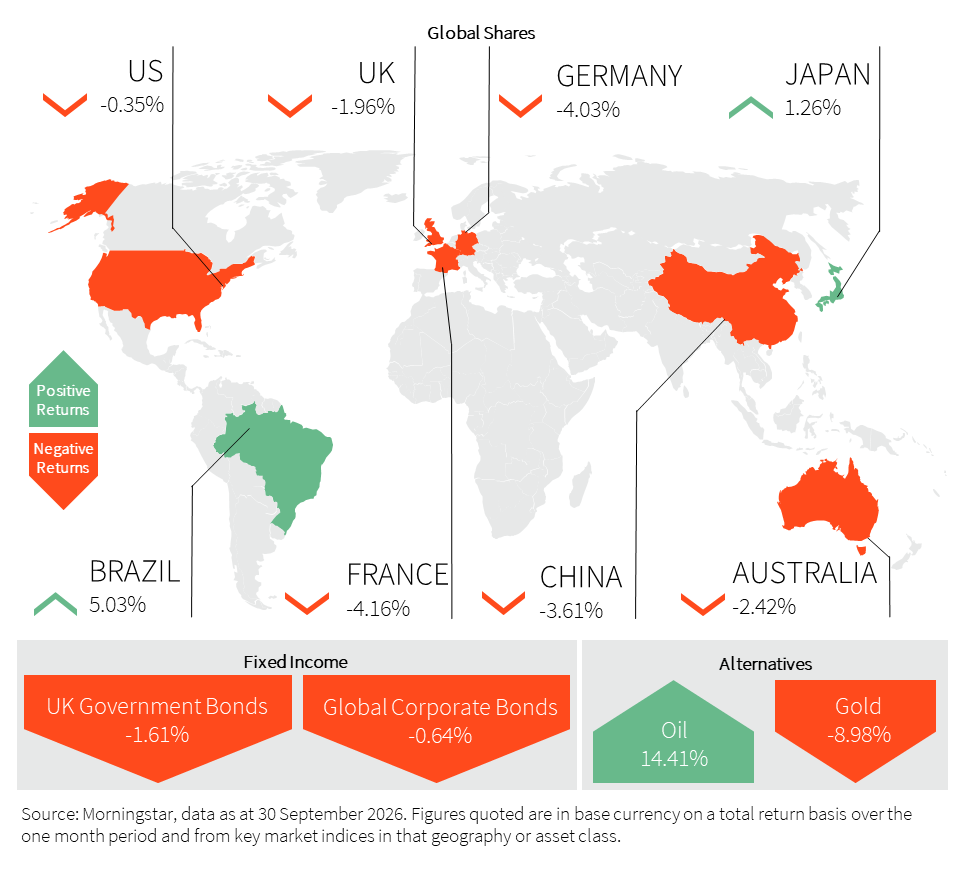

World Market Summary
Standout earnings growth* has remained a key support for equities, with performance lagging company fundamentals and resulting in valuations becoming progressively cheaper as the quarter progressed. Unusually, bonds attracted more attention than equities, with a surge in volatility as government bonds sold off. Oil prices were partially responsible, with Brent Crude oil prices surging above $100 per barrel, as an escalation in the Middle East conflict resulted in Saudi Arabia closing a major oil pipeline. This move higher in global bond yields was most visible in the US and Japan 10-year government bond yields surpassing 5% and 3%, respectively. Yields had not reached this level in Japan for three decades. Whilst US Treasury Secretary Scott Bessent’s intervention has been somewhat effective in thwarting the yen weakness, the US debt buyback has not prevented Treasury yields from continuing to climb, with 30-year mortgages now in excess of 7% for the first time in more than two years. Beyond inflation concerns, the bond yield move is also a function of continued US economic strength, ballooning government debt and ‘hyperscaler’ bond issuance to fund the vast amount of artificial intelligence (AI) capital expenditure. The market is now pricing three to four interest rate hikes over the next 18 months, including one in October, which looks excessive given the Federal Reserve (Fed) will likely want to remain politically neutral on the eve of the midterms.
The macro picture is broadly strong, with the global industrial recovery still intact, as evidenced by most major economies seeing Purchasing Managers’ Indices (PMIs) sitting firmly in expansionary territory, with September 2026 US data pointing to its strongest expansion since July 2021. Meanwhile, economic growth is mirroring the resilience seen in earnings growth. The Atlanta Fed Gross Domestic Product (GDP) tracker now expects US economic growth of 5.1% for Q3 2026, and Indian GDP growth hit 7.8% in the latest quarter. Entering this year, central banks largely leaned towards reducing interest rates, even where inflation was above the targeted 2%. However, economic strength, albeit with renewed inflation concerns, has enabled a more hawkish shift as demonstrated by the Fed, European Central Bank (ECB) and Bank of Japan’s decision to raise interest rates. The Fed’s hawkish tone resulted in dollar strength and a sharp sell-off in gold over the month, which we would expect to unwind in the coming months as interest rate hiking expectations are reined in.
As we head into the final quarter of the year, politics will once again crowd the news flow as the Republican Party continues to face pressure from an electorate pushing for change. It seems that Republicans have a very slim chance of maintaining power in both the Senate and House, whilst Brazil also faces an important election which may see President Lula unseated.
*Earnings growth: Measures how much a company’s profits increase over a specific period.
Our in-depth views on:
Our weightings are based on sterling as a base currency.
United Kingdom (UK)
UK equity markets eased back in September as a cacophony of risk turned sentiment sour. With no sign of a resolution of the Middle East conflict and the Houthi advances in Yemen opening up a dangerous new front, oil rose again and stoked fears of higher inflation. At the same time, concerns over government debt piles pushed the yield on the 30-year UK gilt to over 6% and the highest level in three decades. The FTSE 100 fell 1.96% and the FTSE 250 slipped 1.43%.
Despite the Fed raising interest rates in the US, the Bank of England (BoE) monetary policy committee remained steadfast and held at 3.75%. They did, however, hint at lifting rates should energy costs remain elevated and markets are already pricing in a couple of rate rises. Diesel, in particular, has seen its price rise over 40% since the start of the Middle East conflict and could go even higher should the US follow through on an export ban. The latest UK inflation data showed prices rising 3.1% year on year, in line with expectations, with core inflation holding at 2.6%. Interestingly, shop price inflation is easing as retailers ramp up promotions to help drive demand.
Thus far, UK Prime Minister Andy Burnham and his Chancellor, John Healey, appear to have learnt from their predecessors of what not to do in the lead up to a Budget. As such, they have made some positive statements on measures that will be released at the Autumn event. One such policy will be the re-introduction of a help-to-buy scheme for first-time buyers. This is a much-needed injection into a sector which is being hampered by low demand in the wake of high mortgage rates.
Elsewhere in domestic economic news, the readings were solid. UK GDP was revised upwards for the second quarter to 0.5%, meaning the UK grew at the same pace as the US for the first six months of 2026. Retail sales climbed 0.5% in August, defying expectations of a 2% fall, as the heatwave boosted purchases of fans, air-con, sports merchandise and clothing.
United States (US)
AI continued to be the key driver of US equity performance in September, with a marked difference in returns for the technology-focused Nasdaq 100 and the S&P 500 which gained 3.3% and shed 0.35% respectively. The Russell 2000, which is more tilted to smaller and mid-sized companies, fell 5.40% as the increase in bond yields has an outsized negative impact on these typically more indebted companies. The more positive sentiment for Nasdaq 100 constituents was helped by stellar earnings from memory chip-maker Micron, and the world’s largest company, Nvidia, now has its sights set on $6 trillion market capitalisation after surpassing $5 trillion earlier in the quarter.
The largely flat performance for the S&P 500 has resulted in the index trading very cheaply at 19x the estimated company’s future earnings. However, these forward earnings are based on optimistic earnings expectations, with analysts expecting 32% earnings growth for full-year 2026. Earnings show no signs of slowing in the near future, but should bond yields continue to rise, the economics for further AI capital expenditure will deteriorate for the ‘hyperscalers’ as they are increasingly forced to turn to the bond market given their depleting free cash flow. Any announcements from these companies that they will not continue to accelerate AI capital expenditures could halt the AI rally, but mid-term elections are likely to be the source of volatility in the more immediate future.
The US economy remains remarkably resilient despite diesel prices surpassing $6.50 per gallon, the highest level on record. Real GDP grew at a 2.2% annualised pace in Q2 2026, up from the previously estimated 1.5%, and the Atlanta Fed GDP forecast is currently sitting at 5.1% for Q3. PMI is also sitting firmly in expansionary territory, with September’s figure pointing to the strongest expansion since July 2021. The labour market remains relatively soft, in a ‘low hire, low fire’ environment, and we would expect this to be one of the key checks on the Fed hiking interest rates another three to four times, as the market currently expects.
Europe
European equities fell in September, with France and Germany underperforming the broader region. Higher energy costs weighed particularly on industrial and consumer-oriented stocks and added to inflation concerns, increasing uncertainty around the ECB’s policy path.
Underlying growth data remained relatively resilient. The Eurozone composite PMI improved and comfortably exceeding expectations. German private sector activity also strengthened, and French activity returned to growth for the first time in 10 months. Germany’s business sentiment also rose for a fifth consecutive month, its highest level since May 2023. Defence, infrastructure and AI-related services have supported growth more than consumer demand. The recovery therefore remains uneven, with German consumer confidence weakening sharply and expectations falling short of forecasts, suggesting that improving business activity has yet to translate into stronger household confidence.
Inflation has become a greater constraint. Eurozone headline inflation accelerated to 3.2% in August from 2.9% previously, driven by higher energy costs, although core inflation remained more contained at 2.4%. France’s inflation rate also accelerated to 3.0% in September, with energy inflation rising sharply. Higher energy prices increased input costs and selling prices at the fastest pace in four months, increasing the risk that the initial energy shock feeds into broader inflation.
Against this backdrop, the ECB faces a more difficult policy trade-off. Resilient activity provides some support to the growth outlook. Still the energy-driven inflation shock has raised the bar for further monetary easing and increased the risk of a more hawkish policy stance.
Asia & Emerging Markets (EM)
Asian emerging markets delivered a mixed performance in September, with Taiwan and other technology-related markets supported by continued optimism around AI investment and semiconductor demand. Meanwhile, China remained a drag on the region. China’s economic data continued to highlight a divergence between resilient manufacturing and weaker domestic demand. Industrial production accelerated to 5.2% year-on-year from 4.5% in July, supported by higher-value-added manufacturing, while retail sales growth slowed to just 0.4%. Property remained a major drag, with real estate investment down 19.9% in the first eight months, while weak credit growth and continued contraction in household borrowing reinforced weak domestic demand. The extension of the US-China trade truce by two months should also support exports, likely further widening the gap between manufacturing and domestic demand.
Japan moved further into monetary normalisation, with the BoJ raising rates by 0.25% to 1.25%, the highest since 1995. Inflation eased to 1.7%, although core inflation remained firmer at 1.9%. Higher energy costs also pushed imports up faster than exports, adding to inflation risks and supporting the case for further policy normalisation.
India retained stronger growth momentum, with S&P raising its 2027 growth forecast to 7.0% following robust Q2 2026 activity. However, higher oil prices, a weaker rupee and geopolitical risks could keep inflation elevated and limit the scope for further monetary easing.
South Korea continued to benefit from strong semiconductor exports and AI-related demand, although domestic demand remained softer. In Brazil, monetary easing continued as the central bank cut rates by 0.25% and the possibility of a change of government in the upcoming election generated improved market sentiment.
Fixed Income
Bonds performed poorly across the board as volatility picked up and yields surged. The key cause was clear as the correlation between oil and the US 10-year yield reached its highest level since the 1990s. The most notable moves were that of the US and Japan, where the 10-year government bond yields surpassed 5% and 3% respectively. The sell-off in the UK has been slightly more muted as the bond market is thus far giving Burnham the benefit of the doubt ahead of the Autumn Budget. This was the case at the short end of the yield curve as well as the long end of the curve. The short end of the curve depends more on central bank policy expectations, and given that the UK economy isn’t exhibiting the same strength as the US, the BoE is rightly proceeding with more caution as central banks move more hawkish.
This sell-off in government bond yields gave rise to an increase in credit spreads, as higher yields translate into higher financing costs for corporates and therefore reduce their balance sheet quality. This has been especially true for the ‘hyperscalers’ where on average the group are free cash flow negative and the incremental AI capital expenditures are being funded from an increasingly wary and heavily supplied debt market.
Alternatives
Brent Crude remains on track for both monthly and quarterly gains, reflecting the prolonged Middle East conflict and ongoing supply disruptions, although prices eased back towards month-end as energy flows from the Middle East improved and the US announced another major release of emergency reserves. The 10-day average of crude exports from the Middle East has recovered to 98% of pre-conflict levels, as Saudi Arabia resumed exports through its East-West pipeline at around half capacity, while oil continues to flow through the Strait of Hormuz via alternative shipping routes. In the US, the government plans to release up to 40 million barrels from the Strategic Petroleum Reserve (SPR) to ease fuel prices, while industry data showed US crude inventories rose by one million barrels last week. European natural gas prices were on track for a modest monthly decline, although risks to European supply remained as disruptions to liquefied natural gas (LNG) shipments through the Strait of Hormuz continued.
Gold remained under pressure as concerns over energy-driven inflation and hawkish Federal Reserve comments pushed US Treasury yields higher. The 30-year Treasury yield reached 5.62%, its highest level since 2002, increasing the opportunity cost of holding non-yielding assets and contributing to an 8.98% decline in the precious metal.
Iron ore futures edged higher from eight-week lows as China’s manufacturing sector returned to growth in September, improving the near-term demand outlook. However, trading and economic activity are likely to slow during the week-long National Day holiday, while weak steel demand and deteriorating mill margins continue to weigh on the iron ore market.
Property
The housing sector remained under pressure in September, with the lacklustre demand exacerbated by the latest move higher in bond yields. The average 30-year fixed mortgage rate in the US rose to 7.30% in the week ending 25 September, which was its highest level since late November 2023. This fed into weak demand, with mortgage applications falling 6%, marking a fourth straight weekly decline. Meanwhile, refinancing applications dropped 8.7%, and purchase applications fell 4.3%.
According to Nationwide, UK house prices grew just 0.8% over the last year, down from 1.8% previously, and prices fell 0.2% on a monthly basis. This marked the lowest level of price growth since December last year. Nationwide Chief Economist Robert Gardner stated that “affordability is improving as house price growth has remained well below earnings growth for some time, although higher mortgage rates have partially offset these gains”. Construction PMI eased more than expected in August, with survey respondents noting fresh weakness in demand conditions from clients, which caused a drop in new projects, especially in residential construction starts.
Learn more…
For more industry terms and definitions, visit our glossary here.
Important Information
All Index data figures are sourced by Morningstar and correct as at 30 September 2026, unless otherwise stated.
The value of investments or any income arising from them may fluctuate and are not guaranteed. Past performance is not necessarily a guide to future performance.