
World Market Summary
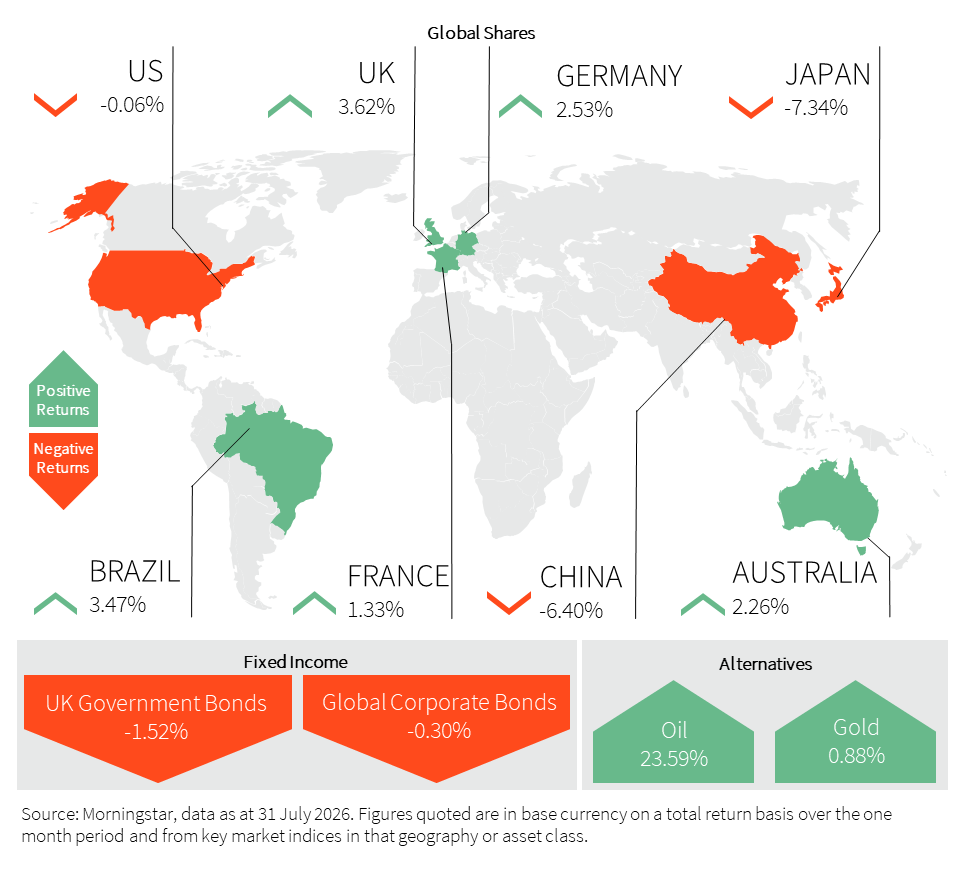
The odyssey continued for market participants in July, as the weak seasonality of the summer months continued to be the Achilles’ heel for market momentum, with artificial intelligence (AI) stocks in particular under siege from Chinese competition. Crucially, economic data and earnings portray a much more resilient picture. Of the S&P 500 companies that have reported so far in Q2 2026, 86% beat expectations and earnings are on pace to grow a remarkable 37% on an annualised basis. However, these earnings are being met with some temporary caution in markets, especially for AI stocks, which was clearly evident in the US stock indices where the S&P 500 was largely flat, but the tech-oriented Nasdaq shed -6.59%. The caution was also clearly reflected in the muted response to stellar earnings from the US banks, whilst earnings below expectations from IBM saw a record 25% fall for its shares. The sell-off was once again particularly stark for memory-chip producers which resulted in another heavy sell-off in the tech-heavy Korean and Japanese indices.
Continued acceleration in capital expenditure from the ‘hyperscalers’ has led to free cash flow turning negative for much of the ‘Magnificent 7’*. Mixed reactions from market participants ensued dependent on the level of comfort that a clear return is being generated from this vast capital expenditure. Amazon presented the clearest example of this return, with cloud revenue up a further 37%.
Since entering the Federal Reserve (Fed) last month, Kevin Warsh is increasingly taking the shape of a Trojan horse. When he was announced as Fed chair, the bond market felt reassured about the future of monetary policy, but his actions and limited words are providing anything but reassurance thus far. Opaque commentary and the absence of a clear plan to quell inflation provided further downside pressure to equities as the US 30-year government bond yield rose above 5.2% for the first time since the global financial crisis of 2007.
The corresponding dollar strength resulted in the yen sliding to a four-decade low past ¥163 over the course of the month and the Japanese 10-year government bond yield rising to a three-decade high of 2.9%. The US and Japan’s coordinated intervention pushed the currency back below ¥160, before the Bank of Japan (BoJ) matched the Fed’s decision to hold interest rates.
UK equities were one of the strongest performers over the month as investors rotated away from growth stocks and sought refuge in the high-yielding market. Even within the UK, there was a rotation away from larger capitalisation names, with the FTSE 250 outperforming the FTSE 100.
*’Magnificent 7′ companies: Alphabet, Amazon, Apple, Meta Platforms, Microsoft, Nvidia, and Tesla.
Our in-depth views on:
Our weightings are based on sterling as a base currency.
United Kingdom (UK)
Like the weather, UK markets were hot in July as ‘old economy’ stocks trumped the ‘new economy’ as jitters over AI spending resurfaced, as did concerns over Western dominance in this field in the wake of Chinese competition. The rotation into lower valuation equities saw the FTSE 100 hit a new record high at the end of the month. The FTSE 250 also outperformed, pushing the index to a level not seen since 2021. It isn’t, however, solely low valuations that are driving the UK markets, as July has also proved a strong month for UK, earnings with the likes of BAE Systems, Rolls Royce, Croda, Unilever and AstraZeneca all beating estimates. Schroders has also christened the UK as the ’share buyback capital of the world’ with nearly 60% of UK large cap companies buying back stock.
July also saw Andy Burnham officially take office with Rachel Reeves removed as Chancellor and replaced, somewhat unexpectedly, by ex-defence secretary John Healey. To date, bond markets have been little altered since his appointment, but the UK 30-year government bond yield remains around its all-time highs. Defence stocks have seen the biggest benefit, but time will tell if he is able to meet his target to spend 3% of Gross Domestic Product (GDP) on defence by 2030. In an initial boost to cost-of-living pressures, the 5% value-added tax (VAT) on domestic energy bills will be removed from the start of October.
Economic readings were supportive of equity markets, with a number of key indicators looking more positive. Consumer confidence has improved since Burnham took office, and retail sales grew 4.2% year over year in June, supported by the warmer weather and the World Cup. GDP data showed a month-on-month improvement coming in at 0.1% growth in May up from the 0.1% decline registered in April.
As expected, the Monetary Policy Committee held interest rates at the July meeting in the face of upside inflation risks from energy shocks. That said, inflation fell to a better-than-expected 2.6% in June with core inflation continuing to ease. There continue to be fears, however, that the lingering indirect effects from the Middle East conflict may push up inflation again later this year. The drought conditions in the UK may also have an impact on food prices.
United States (US)
Despite an end of month bounce, the Nasdaq continued to lose momentum in July and notched its second straight month of losses, with ‘hot’ sectors like semiconductors seeing double-digit declines. News that China has begun producing home-grown immersion deep ultraviolet lithograph machines (a crucial cog in the chip-making process) reminded investors that Western dominance in the AI space is not assured despite the astronomical spending. The Nasdaq declined over -6.5% through the month, with the Dow Jones strongly outperforming and just in positive territory.
Below the headline moves, one can certainly paint a more positive picture when viewing the earnings. With over 60% of companies in the US having now reported in Q2 2026, annualised earnings growth has come in at 37%, with 86% of companies beating. This is exceptional, with the ‘Magnificent Seven’ continuing to see earnings growth well above average. Microsoft saw the standout move in the month as its earnings impressed, with the shares surging and seeing their largest one-day gain in nearly 20 years.
Indications suggest Spain wasn’t the only winner from the World Cup, with the US economy set to receive a $20 billion boost. The Bank of America’s July Consumer Checkpoint report found a 6.3% year-on-year increase in credit and debit card spending across the country, the strongest growth in four years. Bars, restaurants and hotels in the host cities saw the most benefit of this.
The Fed held interest rates steady in July, but for the first time in a decade, three members dissented and called for a hike in the wake of continued heightened inflation. There was, however, slightly better–than-expected news on the inflation front, with headline inflation cooling and coming in at 3.5%. The Fed’s preferred measure fell 0.3% in June, again coming in lower than forecast.
Europe
European equities were flat over the month, providing good diversification from AI-centric sell-off. Markets also benefited from Brent crude prices largely remaining below $100 per barrel, although tempered by renewed geopolitical tensions in the Middle East and the announcement of fresh US tariffs on several trading partners, including the European Union (EU).
Economic data painted a more encouraging picture than expected. Eurozone GDP expanded by 0.4% in the second quarter, ahead of consensus forecasts, supported by AI-related investment, government spending and continued strength in Spain, which remained the region’s fastest-growing major economy. Business activity also improved, with both manufacturing and services Purchasing Managers Indices (PMI) returning to expansion territory, suggesting the slowdown seen earlier this year may be beginning to stabilise despite ongoing geopolitical uncertainty.
Inflation, however, remained a key focus for investors. Headline inflation edged up to 2.9% in July as higher energy prices following the Middle East conflict fed through to the broader economy. Although there is little evidence that higher energy costs are creating widespread indirect inflationary pressures, the European Central Bank (ECB) maintained a cautious stance, holding interest rates unchanged while signalling that further interest rate hikes remain possible should inflation prove more persistent. Markets are now pricing in a high probability of another rate increase later this year.
Overall, the Eurozone economy has proven more resilient than expected, with stronger growth and improving business activity helping to offset external headwinds. However, the outlook remains closely tied to developments in energy markets and geopolitics.
Asia and Emerging Markets (EM)
Emerging markets (EM) in Asia experienced a volatile month as investors reassessed AI-related valuations amid geopolitical tensions and higher energy prices. South Korea was the weakest performer, with the Korean market falling more than -20%, while Taiwan and mainland China each declined by more than -6%. In contrast, Hong Kong’s Hang Seng Index gained over 10%, supported by large internet platform companies.
Japan’s Nikkei fell more than -7%, reflecting the broader technology sell-off and concerns that tighter monetary policy could weigh on valuations. The BoJ kept interest rates unchanged at 1.0% but adopted a more hawkish tone, citing inflationary pressures from yen weakness and AI-related capital expenditure. Food inflation remained elevated at 3.2% year-on-year as the weaker yen pushed up import costs. Markets are now pricing a meaningful probability of a September rate hike. The yen received temporary support following the first coordinated currency intervention by the US and Japan in 15 years. However, the currency’s longer-term outlook remains constrained by wide interest rate differentials between the two countries.
China’s economy continued to show a divergence between resilient exports and weak domestic demand. Second quarter GDP growth missed expectations, while manufacturing activity slipped back into contraction, with the PMI falling to 49.2 in July. Weak property investment and soft consumer confidence continued to weigh on domestic activity. By contrast, exports remained a bright spot, rising 27% year-on-year, driven by semiconductors and other technology products. Policymakers reaffirmed their commitment to fiscal support and accommodative monetary policy, although investors continue to await more meaningful measures to revive domestic demand.
Elsewhere, India came under pressure from higher oil prices and renewed Middle East tensions, which raised concerns over imported inflation, the current account and the monetary policy outlook. Meanwhile, business surveys showed activity expanding at its slowest pace in more than four years, reflecting weaker demand, higher input costs and geopolitical uncertainty.
Despite the recent correction, the long-term outlook for the regional AI supply chain remains constructive. Taiwan Semiconductor Manufacturing Company (TSMC) continued to report robust AI hardware demand, while Samsung Electronics and SK Hynix announced AI supply agreements worth a combined $950 billion, suggesting the recent weakness in semiconductor equities reflects a reassessment of valuations rather than a deterioration in underlying demand.
Fixed Income
Bond market volatility surged over the month as global bond yields hit their highest level since the global financial crisis. The economic data is largely pressuring central banks to increase interest rates as the global economy continues to hold up well whilst inflationary pressures remain rife, with AI-related bottlenecks and the continued conflict in the Middle East. Whether this is the interpretation of the Fed is another matter. The lack of clarity was visible prior to the Fed’s July meeting, with a 30% chance of an interest rate hike priced into the market and the ambiguity only increased in response to Kevin Warsh’s commentary following the Fed’s decision to hold interest rates unchanged. Not only is there ambiguity on the planned direction for monetary policy, but there is also limited direction on how the Fed will respond to a given scenario. This uncertainty has led the market to require greater compensation for holding US Treasuries. Hence, the move in the 30-year government bond yield above 5.2%. The Treasury yield naturally has global implications and the consequent dollar strength participated in the yen’s fall to a four-decade low past ¥163 over the course of the month and the 10-year Japanese government bond yield rising to a three-decade high of 2.9%. UK government bond yields also moved higher, but given the greater weakness in the labour market and softer inflation data, interest rate hikes appear less likely than across the pond.
Globally, credit spreads also widened, particularly for the ‘hyperscalers’ as bond issuance expands and they turn free cash flow negative.
Alternatives
The Middle East conflict continues to be the key driver of oil markets, with the fragility of the ceasefire between the US and Iran very evident in July. The break in the ceasefire caused Brent crude to surge over 20% to finish the month close to $90. During the month, prices hit $100 for the first time since May as Houthi militia attacked oil tankers in the Red Sea. As the conflict continues, supply remains strained as tanker traffic remains limited through the Strait of Hormuz. The International Energy Agency estimate that ’cumulative supply losses from Middle East Gulf producers already exceed one billion barrels with more than 14 million (barrels per day) of oil now shut in’.
Real yields remained an important factor in gold performance, and the move higher in real yields over the month kept the gold price close to the $4,000 that it started the month at. As the main ‘safe haven’ alternative, the dollar also plays a key role in the precious metal’s performance, and the dollar strength on the back of the move higher in yields also prevented further price appreciation for gold. However, the underlying trends of central bank buying, uncertainty over Fed independence and its ability to quell inflation all provide potential for upside going forward.
Property
Property markets remained subdued over the month as elevated borrowing costs continued to weigh on affordability and housing demand on both sides of the Atlantic.
In the UK, house price growth moderated but remained positive. Nationwide reported annual house price growth easing to 1.8% in July from 2.2% in June, while prices edged 0.1% higher over the month. Mortgage rates remained around 6.6%, well above pre-2022 levels, continuing to constrain buyer activity despite easing inflation. Although easing inflation and slower wage growth have reduced pressure on the Bank of England (BoE) to tighten policy further, renewed geopolitical tensions and higher energy prices have increased uncertainty around the interest rate outlook.
The US housing market presented a more mixed picture. New housing starts rebounded strongly in June, largely driven by multi-family developments, while new home sales also recovered as builders continued to offer incentives to attract buyers. However, underlying demand remains constrained by higher financing costs. The average 30-year mortgage rate rose to around 6.7%, its highest level in around a year, weighing on affordability and contributing to weaker mortgage applications, softer existing home sales and lower building permit issuance.
Overall, property markets remain in a holding pattern. Elevated mortgage rates continue to weigh on affordability and transaction volumes, although resilient demand and limited supply should help support prices and reduce the risk of a more pronounced downturn.
Important Information
All Index data figures are sourced by Morningstar and correct as at 31 July 2026, unless otherwise stated.
The value of investments or any income arising from them may fluctuate and are not guaranteed. Past performance is not necessarily a guide to future performance.